

How to Determine the Age of a Rock
Figuring out the age of the Earth and of rocks in general has always been a challenge for geologists. They use two main methods to do it:

 Relative dating
This type of dating is based on interpreting how geological features relate to each other, using a few simple principles. These methods are mainly used to compare the ages of rocks with one another.
A
Principles of original horizontality and superposition
Rocks formed from sediments deposited in a basin were first laid down horizontally, stacking one on top of the other. This means that the layer of sediments at the bottom is older than the layers on top.
 Youngest formations
 Oldest formations
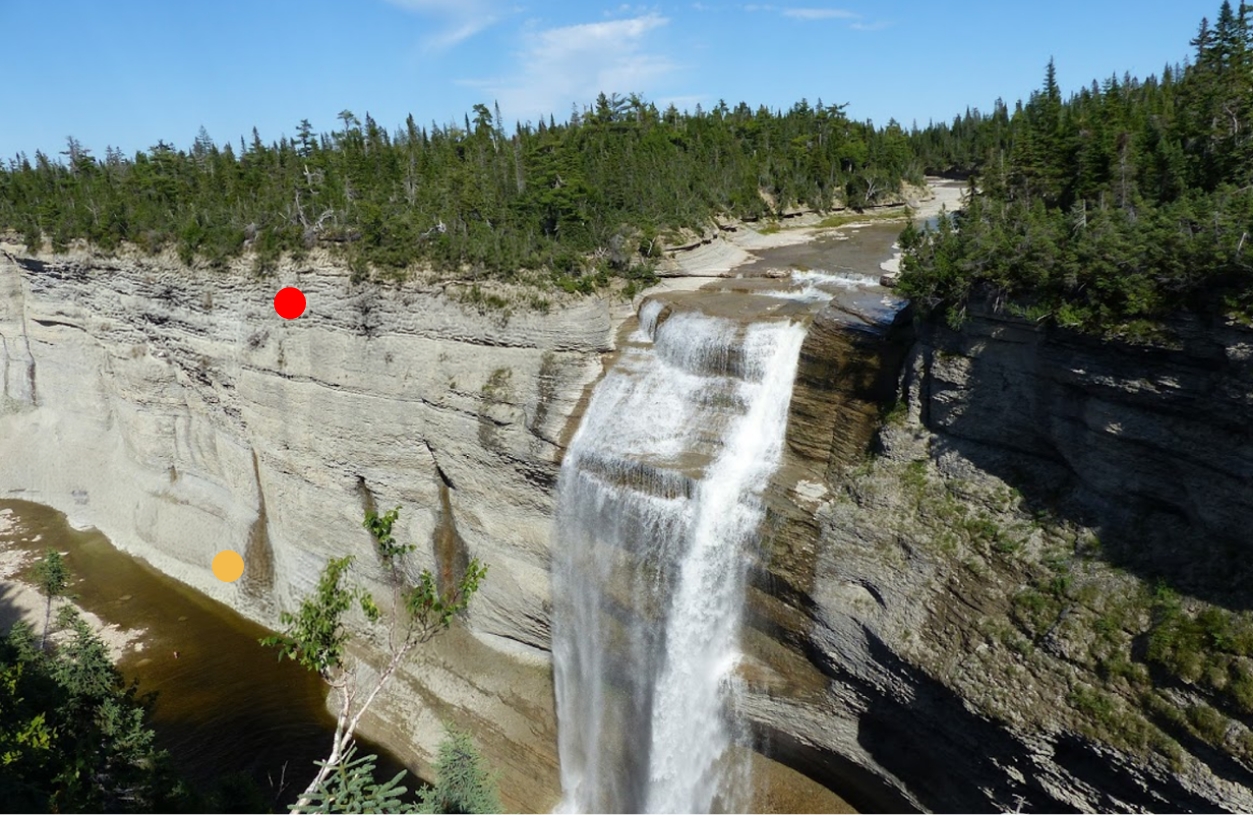
The principles of superposition and horizontality shown at Vauréal Falls on Anticosti Island.
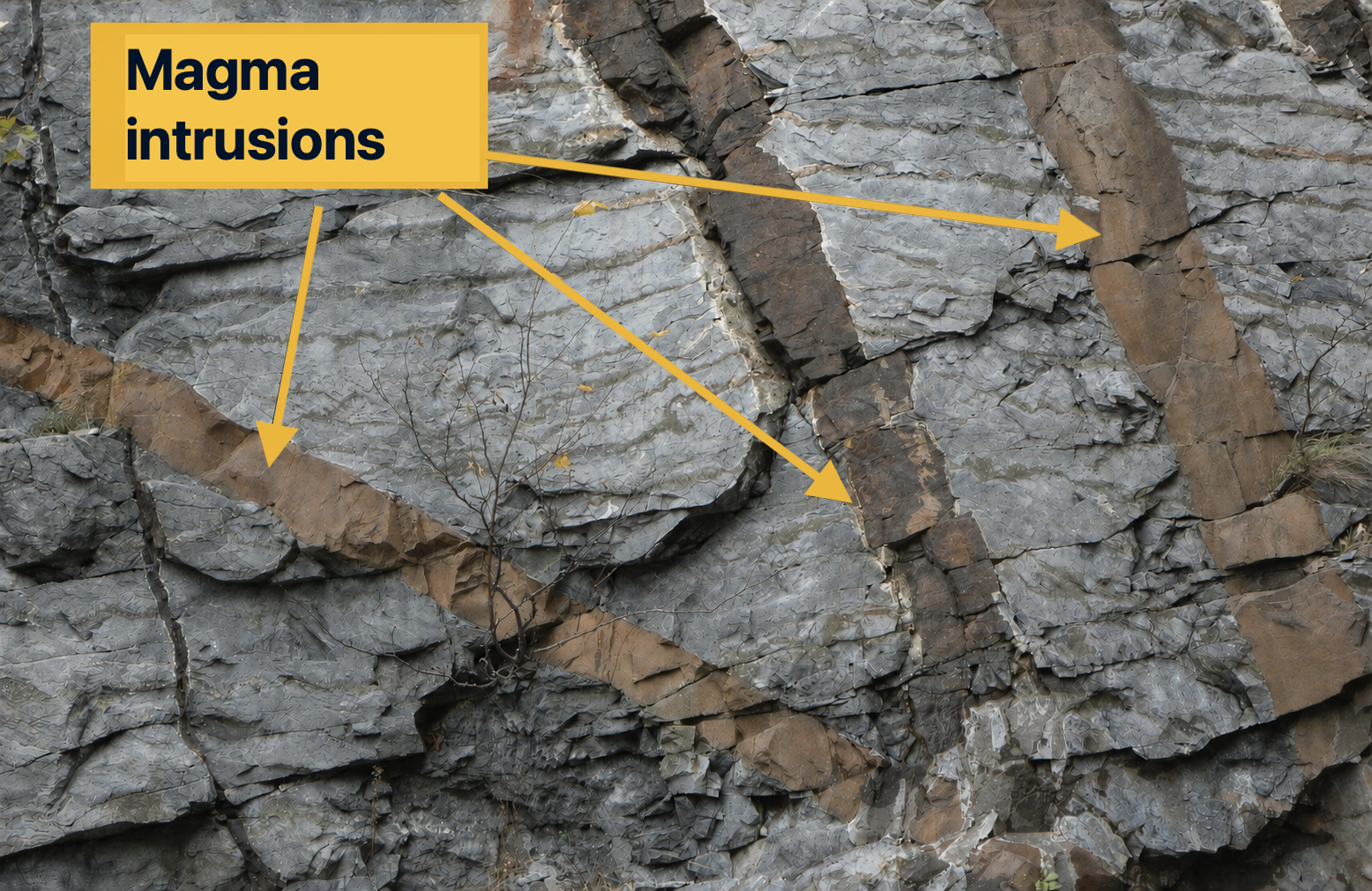
Magma intrusions in Mount Royal limestone. These rocks are younger than the limestone they cut across.
B
Principle of cross-cutting relationships
A rock body that cuts across another one must be younger than the one it cuts across.
C
Principle of faunal succession
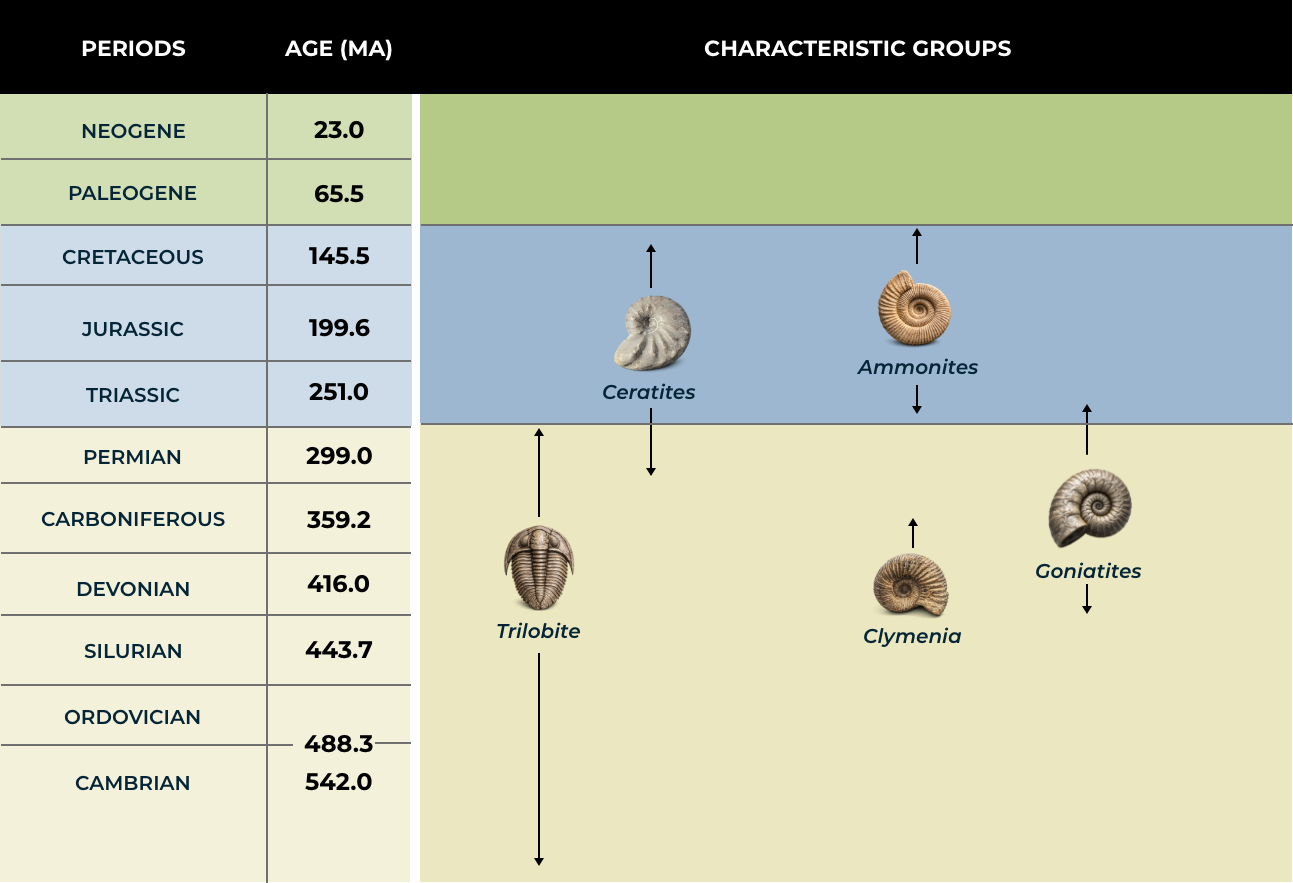
This principle draws upon the evolution of life on Earth and the traces that this evolution has left behind. Since certain species existed only during a specific period, the discovery of their remains in rocks allows us to determine our place in time.
It’s just like a family photo showing 4 generations of the same family: you can estimate the date based on who is in the picture.
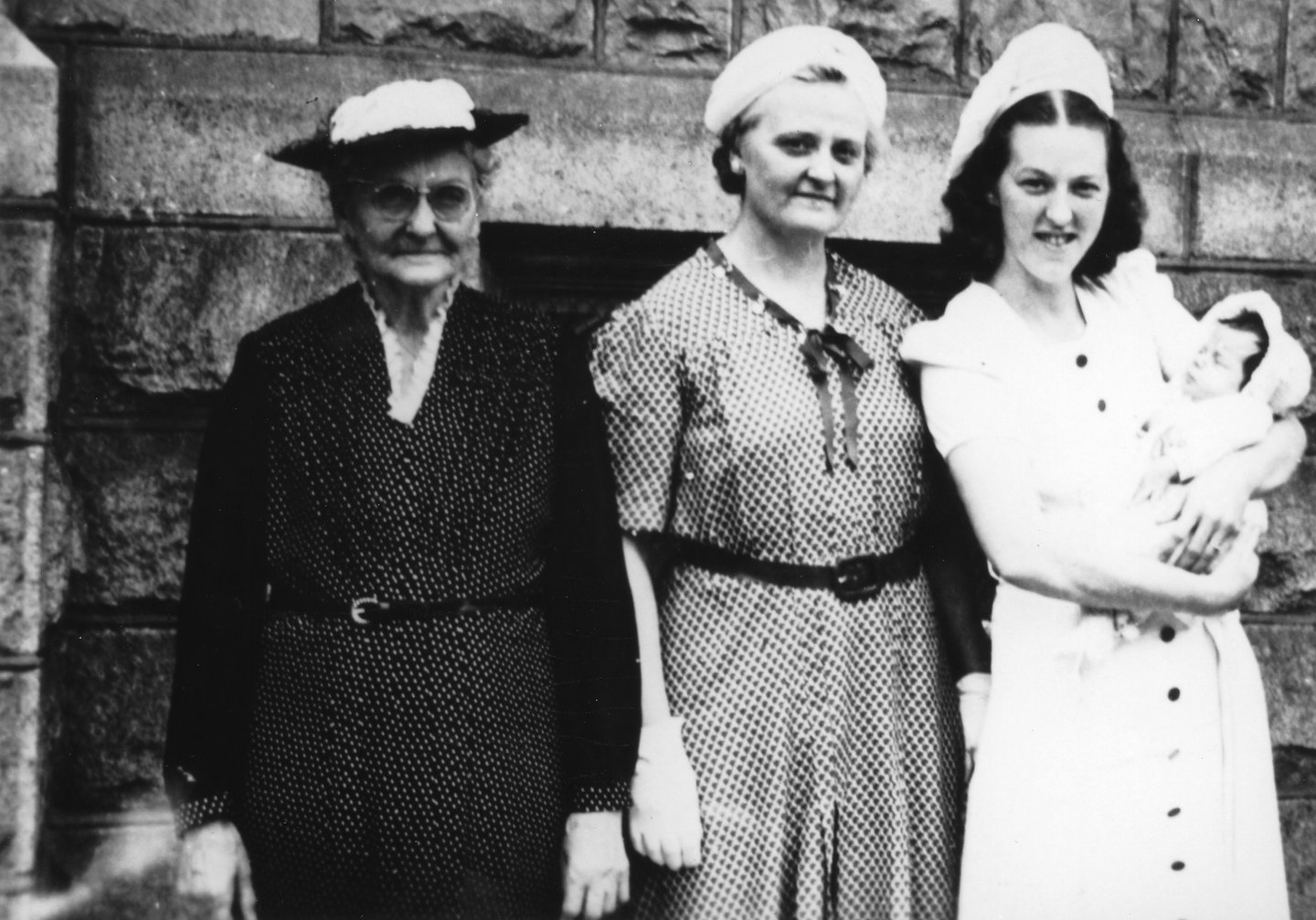
There is only a very specific period of time when a photo of four generations together can be taken
 Absolute dating
This dating method is based on the concept of radioactivity.
Some unstable atoms gradually lose mass as they transform.
To understand this phenomenon, you first need to understand the concept of the atom.
The number of protons in the nucleus determines which chemical element we are dealing with.
For example:
1 proton = hydrogen
12 protons = magnesium
79 protons = gold
For some elements, the number of protons stays the same, but the number of neutrons can vary.
These are called isotopes: the element stays the same, but the mass of the nucleus changes.
Some unstable nuclear configurations cause the nucleus to lose mass in order to reach a more stable configuration.
This phenomenon is the basis of radioactivity, and it is what makes absolute dating of rocks possible.
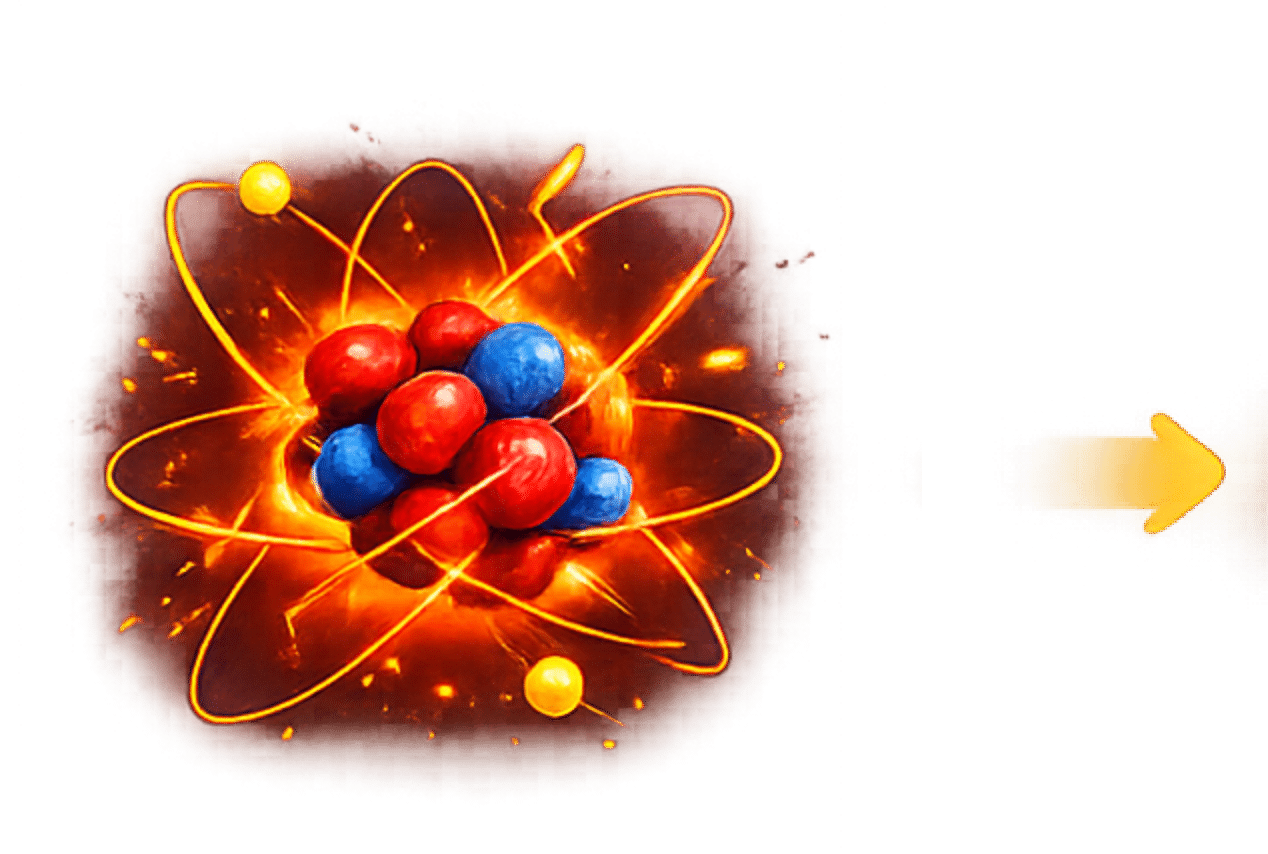
Unstable nucleus

Emission of
particles and energy
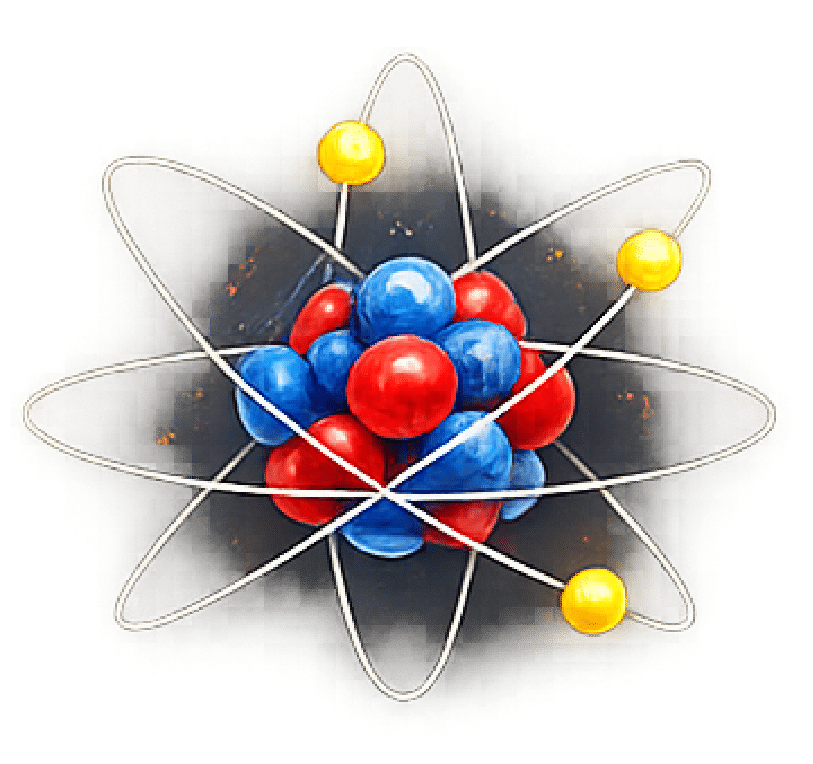
Stable and
lighter nucleus

Proton

Neutron

Electron
An unstable atom naturally loses energy by giving off radiation.
This process turns the atom into another, more stable atom.
This process releases particles and energy in the form of radiation. In significant amounts, these emissions can be dangerous for living things.

How a mineral containing uranium turns into lead over time
Radioactivity is used to date certain rocks.
Here’s how it works, using the uranium-lead (U-Pb) method as an example.
Some isotopes of uranium (U) turn into lead (Pb) at a known rate.
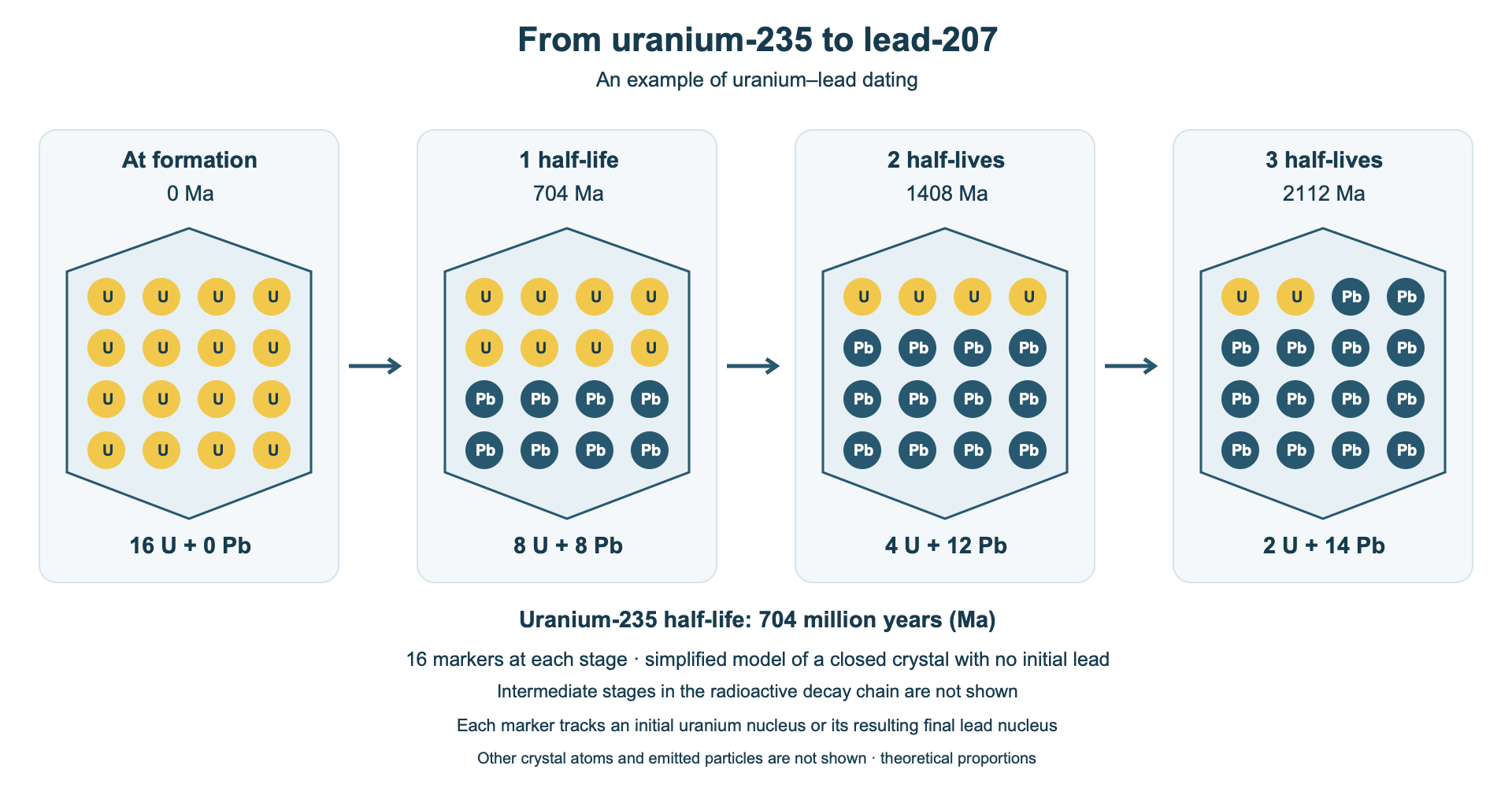
The more lead there is, the older the crystal.
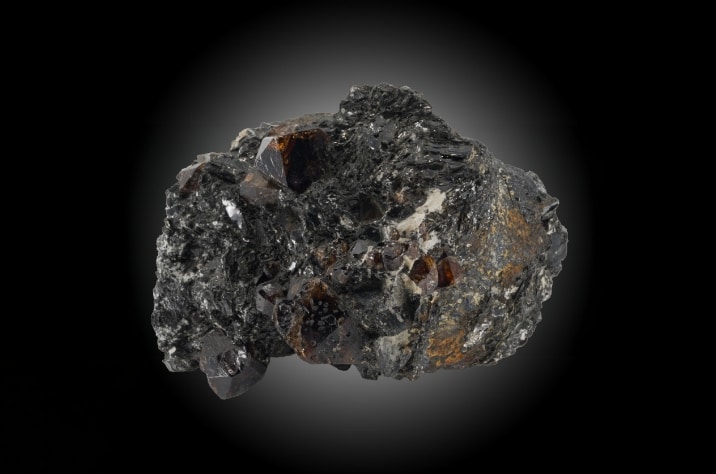
Zircon is the mineral often used in uranium-lead dating.
Zircon from Norway
Zircon is the mineral often used in uranium-lead dating.
At first, this crystal contains only uranium.
Over time, some uranium atoms turn into lead.
By measuring the proportion of uranium and lead, you can estimate the age of the crystal.