

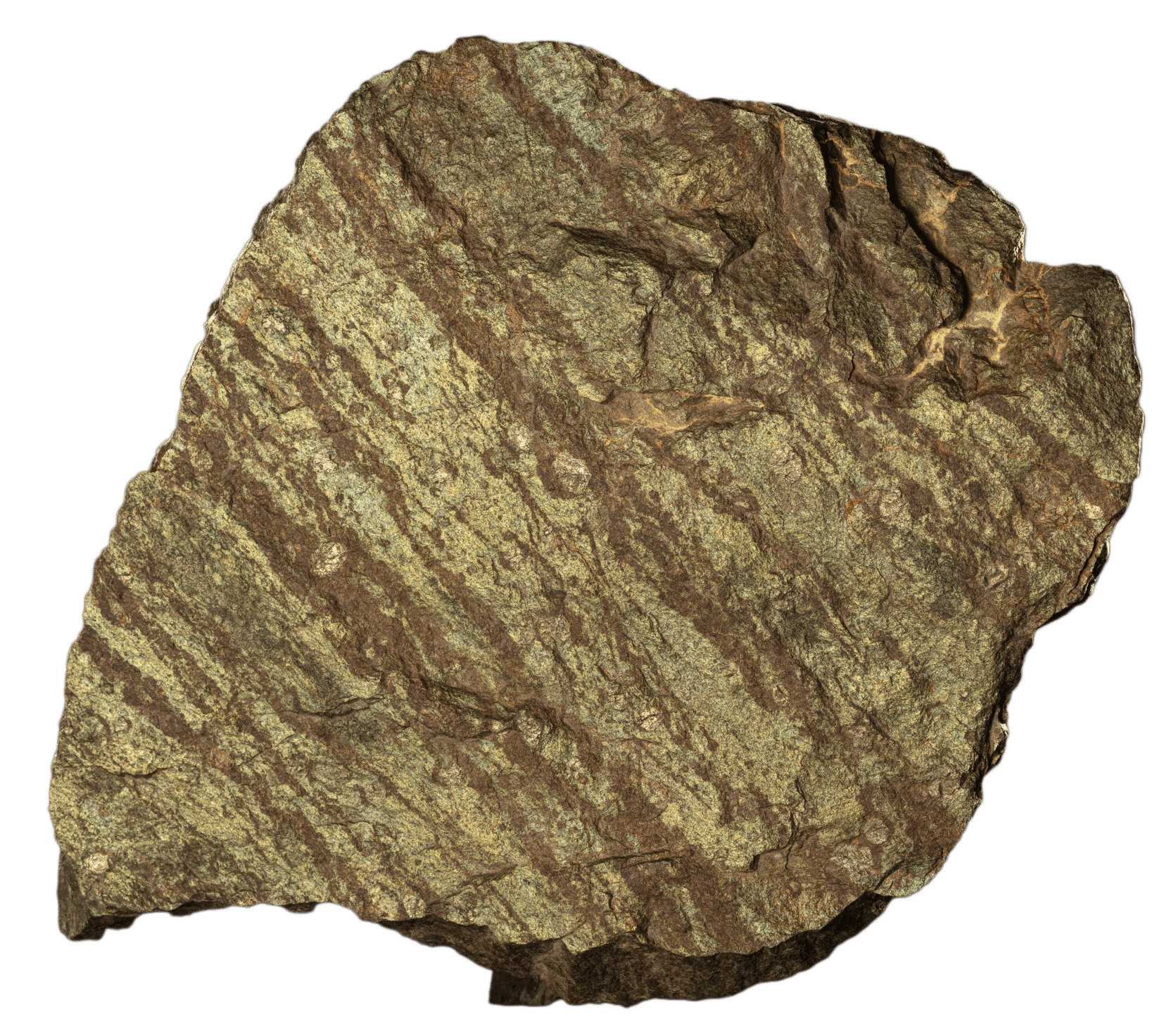
Ore from the Horne mine (1926 to 1976) in Rouyn-Noranda. This mine was worked for copper, gold and silver.
The Challenge
Prospecting for metals involves using a wide range of data, based on what we know about how mineral deposits form.
Can you outline a promising area to explore for base metals?
Let’s try it with a “volcanogenic massive sulfide” deposit.
A block of volcanogenic massive sulfides containing gold, silver, copper and zinc.
How does
this type of deposit form?
Volcanogenic massive sulfides form in a setting of underwater volcanic activity.
Magma linked to volcanic activity is a source of heat. This heat warms the seawater that seeps into the ocean floor. The heated, pressurized water becomes a hydrothermal fluid that leaches many elements out of the rock it flows through, including several metals.
This element-rich water comes back up to the surface at 300 to 400 degrees and, when it meets seawater, releases the dissolved metals it contains. The metals, in the form of sulfides, settle out and build up on the ocean floor.
You can see this happening at the bottom of the ocean, where it creates black smokers:
In this type of deposit, the source of the metals is the ocean floor, they are carried by seawater heated by the magma, and the trap is the chemical reaction that happens when the fluids are released into the sea.